
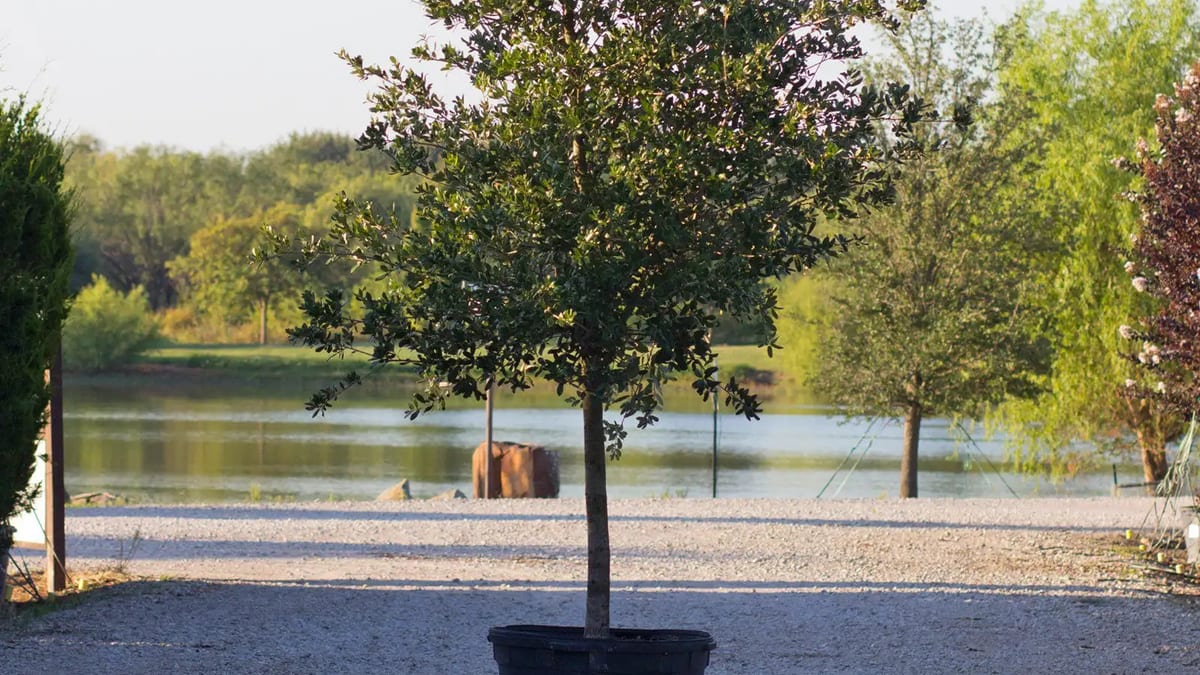
Every August, the same thought crosses every North Texas homeowner's mind: this yard needs shade. Then fall arrives, the thought fades, and the yard bakes again the next summer.
Here is the good news. Fall is the best time of year to plant a tree in North Texas, and the trees below have been proving themselves in blackland clay and alkaline soil for generations. Plant one this fall and future-you sends a thank-you note.
What our soil demands of a tree
Most of the area around Flower Mound sits on heavy clay that is alkaline, slow to drain when wet, and brick-hard when dry. Trees bred for the acidic, loamy soils of the eastern United States often struggle here, turning yellow between the veins no matter how much you feed them. The trees that follow do not need pampering, because this is the soil they were built for.
Live Oak
Quercus virginiana
Evergreen40 to 60 ftModerate growthFull sun
The king of Texas shade. Massive, spreading, essentially evergreen, and nearly indestructible once established. Give it room to become the tree your grandchildren climb. Its one demand is patience: it builds slowly and lasts centuries.
Shumard Red Oak
Quercus shumardii
Deciduous50 to 70 ftFast growthFull sun
The fast-growing oak with genuine fall color, turning deep red when most of North Texas just turns brown. Tall, stately, and clay-tolerant. Buy one grown from Texas seed stock, which is exactly the kind we bring into the yard.
Cedar Elm
Ulmus crassifolia
Deciduous40 to 60 ftModerate growthNative
A true Texas native that grows wild in our river bottoms, which tells you everything about its attitude toward clay and drought. Small, neat leaves, golden fall color, and one of the toughest shade trees you can plant here. Underrated and underplanted.
Chinese Pistache
Pistacia chinensis
Deciduous30 to 45 ftModerate growthBest fall color
If you want a front-yard tree the neighbors ask about every November, this is it: reliable orange-to-scarlet fall color even in our mild autumns. A tidy, rounded canopy at a size that fits suburban lots, and thoroughly proven in alkaline clay.
Bur Oak
Quercus macrocarpa
Deciduous60 to 80 ftModerate growthNative
The gentle giant of the blackland prairie, with huge leaves, golf-ball acorns, and deep roots that make it one of the most drought-tolerant shade trees in Texas. Plant it where it can be enormous, because it will be.
Southern Magnolia
Magnolia grandiflora
Evergreen20 to 50 ft by varietySlow to moderateBlooms
Shade plus year-round green plus dinner-plate summer blooms. Full-size varieties like D.D. Blanchard make a grand evergreen anchor, while Little Gem fits tighter spots. Appreciates a little extra water in its first summers, then settles in.
How to plant a tree in clay, the right way
In clay soil, how you plant matters as much as what you plant. Five rules cover most of it:
- Dig wide, not deep. Two to three times the width of the root ball, but no deeper than the ball itself. A too-deep hole in clay becomes a bathtub.
- Plant a touch high. The root flare, where the trunk widens at the base, should sit slightly above the surrounding grade so water sheds away.
- Backfill with the same clay you dug out. Skip the rich amendments in the hole. Roots need to learn to live in your soil, not circle inside a pocket of potting mix.
- Mulch a wide ring, two to three inches deep, pulled back from the trunk. See our soil and mulch department for options.
- Water deeply and slowly once or twice a week through the first two summers. A slow trickle for an hour beats a daily splash.
When to plant
Fall, ideally. From September into December, warm soil grows roots while the top of the tree rests, so a fall-planted tree enters its first summer already established. We plant trees at the yard right up to mid-December. Spring works too. Summer planting is possible with discipline about watering, but if you can wait for fall, wait for fall. Our month-by-month garden calendar shows how tree planting fits the whole year.
Come kick the trunks
Photos only tell you so much about a tree. Come walk our tree and shrub section, look at the actual specimens, and we will match a tree to your yard, your soil, and your patience level. Stock rotates weekly, so call ahead if you have your heart set on something specific.