
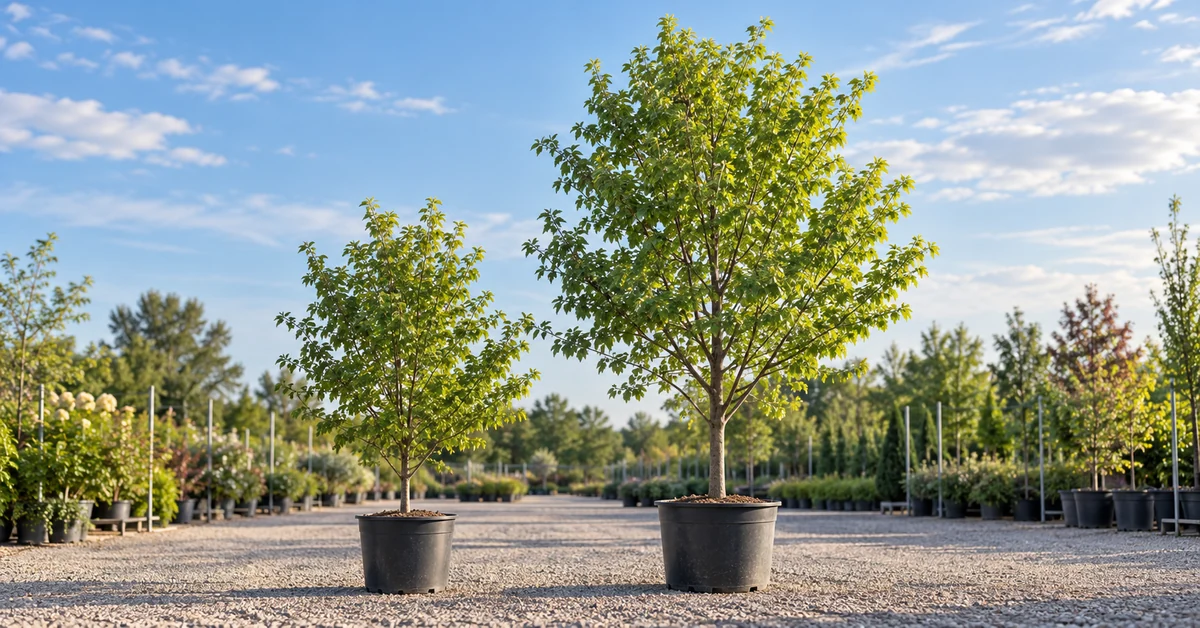
Not automatically. Pay more for a larger nursery tree when its extra size gives you something you value now, the species fits your space, and the tree has healthy roots. Height alone does not make it a better buy. In North Texas, site fit and follow-up care matter more than size alone.
The International Society of Arboriculture emphasizes proper tree placement and care.[2] There is no magic price-per-inch formula. Compare the quoted price with the tree’s fit, visible condition, roots and the care you can provide after planting. This guide is about choosing nursery stock, not landscape installation or a promise about what is available today.
What does the extra cost of a larger tree buy?
It buys a larger starting specimen. That may be worth it if you want a more established look right away and have room, access and a planting plan for that specific tree. It does not buy guaranteed shade next summer, faster establishment or freedom from aftercare. A large canopy can look impressive above the pot, but the root system still needs a close look.[1][2]
Think about the job you want the tree to do. If the goal is shade, judge the tree by its mature size and where that canopy will land, not just its height at the nursery. If it is meant to frame a view or sit near a walk, a smaller tree that fits the space may be the better purchase. The ISA notes that correct tree placement can prevent costly maintenance and repairs later, so site fit belongs in the value calculation.[2] The Land Care guide to shade trees for North Texas clay can help you compare species and site needs before you compare sizes.
Is a smaller tree a better value?
It can be, if you have time for it to grow and the smaller specimen is healthy. You may spend less upfront, handle it more easily and have more flexibility about where it goes. But “smaller” is not a quality grade. A small tree with damaged roots or the wrong mature form is still the wrong buy; a larger, well-grown tree may be worth paying more for when immediate visual impact is your priority.
Make the decision around your yard, not a blanket rule that small always wins or big always pays off. Check the mature width, sun exposure, soil and nearby structures. North Texas clay and heat narrow the choices, so start with the species and planting spot; size comes second. The Trees & Shrubs section is a useful place to begin that comparison. It describes the category, not a live inventory guarantee.
How can you tell whether a container tree is worth buying?
Look beyond the canopy and ask to inspect the root area with a nursery team member. Container-grown trees can develop roots that hit the pot wall and circle; Penn State Extension warns that circling roots can become a long-term problem and recommends examining roots before purchase.[1] The International Society of Arboriculture also advises checking for circling roots and making sure the trunk flare, where the trunk widens into the root system, is visible after planting.[2]
Use these checks before you decide:
- Ask for a closer look at the root ball. If the roots are hidden, ask whether a staff member can show you what to check without damaging the plant.
- Watch for thick roots circling the outside or wrapping around the trunk. If you see them, pause and compare with another specimen rather than assuming a bigger pot means a better root system.[1][2]
- Find the trunk flare. The trunk should widen toward the roots; if it disappears into extra soil or media, ask the nursery to help you locate it.[2]
- Check the whole plant. Look for a balanced crown and an upright trunk without obvious damage. A taller specimen is not automatically healthier.
- Ask what establishment care it needs. A nursery-grown tree still has to adapt to your soil and weather. Use a realistic watering plan after planting; Land Care’s North Texas guide to watering new plants explains why the root zone and conditions matter more than a fixed calendar.
Should you buy the largest tree you can afford?
No. Buy the tree that fits its mature space, has a sound root system and suits your priorities. If a larger specimen checks those boxes and immediate impact matters to you, paying more can make sense. If not, a smaller healthy tree is a sensible choice, not a consolation prize.
Before you commit, ask the nursery team to compare two sizes of the same kind of tree, if both are being considered, and explain what you gain besides height. Then compare the root systems and the planting spot, not just the price tag. Land Care’s Trees & Shrubs page invites shoppers to bring photos so the team can talk through a fit before they spend. Bring a few yard photos and rough measurements; they give the team more context to discuss fit than a quick look alone.
FAQ
Does a bigger nursery tree establish faster?
Not necessarily. A larger canopy does not prove that a tree has a better root system or will settle into your yard more quickly. Check roots and planting conditions, then plan for follow-up care.[1][2]
Is pot size a reliable shortcut for judging tree quality?
No. The container tells you how the plant was presented for sale, not whether roots are circling, the trunk flare is buried or the species fits your site. Ask to assess the individual tree.[1][2]
What should I compare besides the price?
Compare mature size, sun and soil fit, root condition, visible trunk and canopy health, access to the planting spot, and the establishment care you can provide. A tree is a long-term purchase; the cheapest or tallest option is not automatically the best value.[2]
What should I bring when I ask for help choosing?
Bring photos of the planting area, approximate dimensions, and notes on sun and soil conditions. That gives the nursery team context to discuss a tree’s fit before you buy.
Start with the planting spot, then compare the trees. Browse Trees & Shrubs, review shade trees for North Texas clay, and bring yard photos to Land Care Garden Center for a retail plant-selection conversation.